Thursday, April 14, 2011

Dinner with Megan


My friend Megan is the best. She has been such a great friend. She is so willing to help and so fun to be around. I am so lucky to have met her. We were introduced by a mutual friend and we first met through the phone and now that I live here, she is in my ward and I'm always wishing that I had more free to time to spend with her. She is the type of person you would like to hang out with for fun. Last week we went to dinner. Megan treated me to dinner. I met her at her place and then we took the path next to her house and walked for a few minutes (enjoying the sun and the conversation) down to the Vienna Inn. This restaurant is one of the best. I ordered a quesadilla. The price was way low and the atmosphere was way relaxed and almost contradictory to the usual DC standard. I loved it! We had so much fun eating and talking about good sightseeing and monuments and memorials to visit. Our walk back home was fun too. I got scared a couple of times since it was dark. It was the perfect dinner outing. And I still got home in time to take a shower and get some sleep:)

The Cherry Blossom Festival


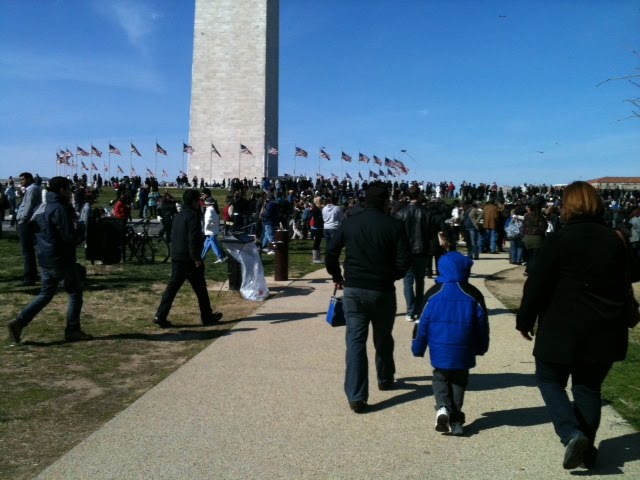
I was lucky enough to be in DC during the cherry blossom festival. What a time to go downtown. On one trip down to DC, the metro train we took was packed with people holding on to the metal poll for dear life. It was so much fun to be part of this festival. I was secretly celebrating the arrival of spring and soon summer. I just love summer. I live for summertime. During the festival you can watch shows on the stage in front of the Washington Monument and enjoy the cherry blossom trees which I learned were given to the us as a gift by the Japanese. I will never forget the Cherry Blossom Festival because it comes at the same time that the YW General Conference is help. Funny!

Tuesday, March 15, 2011

Teaching Experiences

Coming to DC has presented me a number of teaching experiences. Besides all the teaching I do at work. I have been blessed with the opportunity to teach Sunday School at church and to give a talk in Sacrament. As always, I'm the one learning the most. All of these opportunities have helped remind me of some very important principles to effective teaching:
  • The Spirit is always the teacher (even in teaching I do at work)
  • The student need to be engaged, active participants, and to be presented with problems to solve, not just be lectured at.
  • The best teachers are sometimes people without degrees or special training.
  • The most important tool in teaching is the teacher's attitude. (click here for more on this)
  • The best thing we can do in teaching is to make it very easy and simple to understand (even when teaching adults, in fact, more so when teaching adults)
Slightly unrelated to this post, but slightly related....I've decided that whatever I end up doing in my career, it needs to involve people interaction. Lots of people interaction. During the last couple of years, being in school has been tough, but what's actually been more tough is the feeling of alienation you get from sitting in front of the computer for long periods of time. Oh yes. We all know what that feels like! I know some of you reading this are agreeing with me right now. I thought I had learned this lesson back in the summer of 1999 when I had a job at Garcia research, sitting in front of the computer for hours at a time trying to get some hispanic ladies to detach themselves from their soap opera to answer some of my insignificant (and sometimes ridiculous) survey questions. Apparently, I needed to relearn this lesson, but believe me I have. I now know that Andrea needs people interaction. I would like to say that we all do, but there are some people who are happy working with the computer all day. Unfortunately, I'm not one of them.

Friday, March 4, 2011

My Mt. Everest

I have been a student at BYU for almost twelve years now. During these twelve years I have had the opportunities of a lifetime. I have met the most interesting people and have traveled to the most intriguing and adventurous places. I have learned so much and have truly become a different person than when I entered the university. I began as a timid and lost freshman and I will go forth as a confident doctor of technology and education. I remember the first day of my student journey at BYU. I got lost. Literally and physically lost. I couldn't find my way back to Fox Hall Apt 40. I just started crying. I remember how hopeless I felt and how homesick I was. And now as I look back to that day I just smile and realize how far I've come since then. On the other hand, sometimes I feel just as lost as I was that first day at BYU. Coming to DC has really been a turning point in my life. I have realized that we cannot know where we are going if we are lost and only doing what others tell us to do or what we think others want us to do. I think one of the greatest blessings of this journey I commenced twelve years ago has been finding out who I really am and what I want out of life. For some people that answer is simple and comes to them seemingly easily. For me, that has not been the case. This is evident to anyone examining my student record on AIM who can see my eclectic course choices (e.g., Don Quixote, snowboarding, Electronic Manufacturing Processes, Physics for Engineers, Beginning Woodwork, Portuguese and even Beginning Guitar). Hello! How lost have I been! The sad realization that I came to is that after twelve years of this arduous journey, I am still feeling lost! So I decided to stop doing what's next on the checklist and just confront myself and decide what I want to do. Yup. Just me. What do I want?
As I've had some extra time at my current job to think and reflect extensively I have decided that what I really want to do is work with kids again. I miss it so much! I miss feeling a sense of accomplishment at the end of the day, yes, even if that accomplishment also came with a sense of fatigue. I remember when I was teaching high school and middle school. It was tough at times, and I probably won't want my same job back, but I felt so happy working with the kids. It felt like life was fun. Besides the fun, I have a lot more to offer in the field of education now. I would like to work with kids and technology again. Hands on. I don't want to be sitting at a desk writing research papers. I want to get my hands dirty and be at the forefront of the education movement. I miss that in my life. So now, I still feel a little lost, but at least I know the right direction to head. I know what I want and I feel like I'm a hop, skip, and a jump away from getting there. That is a great feeling!
There is power in knowing who you are and what you want to do. So many times in life, you find yourself being labeled, being handed a checklist of things to do, or even being rejected ("rejected by the nerds" as Paula and I like to call it) . If you are empowered to know who you are and what you want in life, choices become easier and barriers to getting there much less intimidating. The trouble is so many people don't know who they are and don't know how to find out. Sometimes we know who we are, but we don't believe it. Deep, deep inside, we don't believe how great we can be. I am grateful that I am feeling closer to my end goal. It is difficult and I don't know if I'm going to get there anytime soon, but at least I'm making progress and that's what counts.
So when I first moved out to DC, my sister Raquel gave me some advice, actually homework. She told me to write down why going to DC would be a good thing and why doing a dissertation was a good thing. The purpose of this task was to remind me of the reasons I had chosen to do these things in the first place. I really needed a reminder of why on Earth I had chosen these things upon myself. I do this to myself often. I decide to do something great and then I realize it's going to be hard to achieve it and once I'm in the middle of doing it I wonder what possessed me to even want to do it in the first place. I loose sight and motivation. Does this happen to you too? Sometimes I wonder if I dream too big. I think I do. Is that a good thing or a bad thing? Our society will tell you it's a good thing to dream big, but sometimes I don't feel like it is a good thing. I feel tired and ready to give up. Sister Dalton once said that the middle of the race on the uphill is not the time to make any decisions whatsoever. Your ability to make good decisions at this point of the race is diminished by the fatigue. The time to make the big decisions is before the race begins. This advice gives me some comfort (to know that it is normal to feel tired in the middle of the journey), but it also makes me feel like maybe I need to think harder at the beginning of my journeys. Why can't I be like normal people who don't dream big?
So to complete the task I've been given, the answer is coming to DC has been a good thing because it has helped me see myself more clearly and it has illuminated the path to my happiness. Doing a dissertation is a good thing because it is a tool that provides truth to the world and it is a tool that will open doors for me in the future. However, both of these things are not an end in and of themselves. There is so much more to happiness than a degree or a great job. I am grateful to know this and to have the opportunity to act upon it to create a better future for myself and those around me.

Thursday, March 3, 2011

The Smithsonian Museum of American History


I went to this museum and got there with a friend just in time for a documentary on Japanese Americans during WWII. The documentary, Day of Remembrance was about the 442nd Infantry of the US Army. The things that struck me the most during the movie was the courage of these men to stand up to prejudice and to prove themselves at a time when they were being victimized and racially discriminated. The movie shows passages of interviews with the veterans and it makes the viewer realize (made me realize) that our freedom and rights have come at a very high price, that we only get one life to live, that racism is one of the most evil threats to humanity, and that we have a lot to be grateful for.

According to Susan

My friend Susan from work gave me some great tips on places I must see before leaving DC http://www.culturecapital.com/?gclid=CPzx1rfTnqcCFQY65Qodu3WUdw
http://washington.org/visiting/experience-dc/sample-itineraries

Georgetown
Mount Vernon
Arlington National Cemetery
China town
Dupont Circle
Adams Morgan
American Universities
The embassies

I'm going to try to go to all of them. We'll see if I get to them all from now till June.

Saturday, February 12, 2011

New Learners of the 21st Century


This Tuesday I was invited to a special documentary reception by PBS on educational technology at the Smithsonian Hirshhorn Museum. It was amazing! I loved going because it reminded me why I love education and technology. If you have some time, click here to watch a preview of the documentary. At the reception I was able to meet the president of PBS in Minneapolis/St. Paul and the Director of Educational Technology at the US Department of Education. After meeting the president of the PBS station in Minneapolis/St. Paul I was bold enough to ask him to take a picture with us. My friend Lindsey was very encouraging and helped me navigate the metro to get there. Some of the major takeaways I had from this experience are:
  • It is irresponsible of teachers to ignore digital media.
  • As adults, we try to control what kids are passionate about, but we should just allow them to be passionate because it is their passion that teaches them how to learn. Every kid has an interest and we just need to facilitate their growth and passion for that interest.
  • DYN- Digital Youth Network is a hybrid digital literacy program
  • There is a need for passionate and competent educators.
  • The need to prepare for an uncertain future and the need to help students survive and interdependent globally connected world.
  • The need to give students credit for learning they do outside of school and to help them integrate their outside life with their school life into one.
  • The role of families- Families benefit from their students learning technologies. Some families facilitate the funding of technologies for their students by participating in a leasing program where they pay and they are able to take the tools home with them.
  • The need to create smart systems that enable families (narrative based report cards, systems that foster longitudinal connectivity)
  • Parents need to be taught the value of technology. If parents know what tech can do, they will do what it takes to make it happen for their students.
  • Parents, teachers and students need to be considered one community, not separately.
  • The need to give students freedom to be creative and make their contribution right now. Going from consumption to production to participation. To give students a voice to tell their stories. There is also a need to explicitly teach digital citizenship.
  • Teachers should begin by asking students "So... what do you think?" and listen to their answer, then create.
  • Schools are wired for technology so they should be open to the public after school for the community to benefit from them.
  • We need to let our students know that who they are and what they can create matters now, not later when they get out of college, but now.
  • Different mediums allow students with different learning preferences to learn.
  • When kids learn technology, they share it with other kids, then they begin sharing it with their families, later they begin sharing it in their communities.
  • The criteria for the use of technology is: ubiquitous, necessary, invisible.
Some of the example assignments that were discussed using technology were scavenger hunts with the use of phones to allow students to take pictures of their findings and create scavenger hunts for other students. Texting was used in these scavenger hunts to give students hints. There was a metaphor assignment in a science classroom that asked students to create a metaphor for a scientific process using digital visual representations. The What If assignment. What if Martin Luther King had not spoken up? What if World War II hadn't happened? Teachers talked about the importance of digitizing all artifacts and making them public and sharable.

The thing that really spoke to me about this presentation was the motivation, happiness, love, passion, and creativity of the teachers. It reminded me of when I was teaching middle school and high school and how much I loved my students and all the fun I had teaching them and learning from them. Working with middle school and high school kids is tough, but if done correctly, it can provide a huge sense of satisfaction and accomplishment.